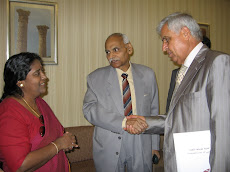
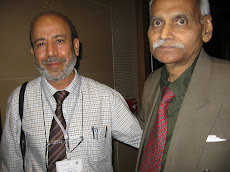
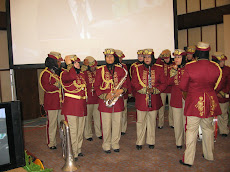
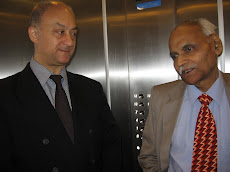
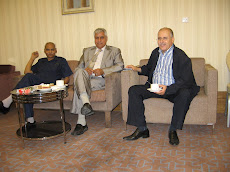
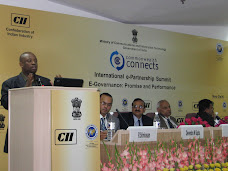
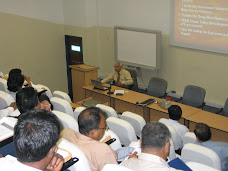
Richard Stallman, Founder of GNU Project and Free Software Foundation, inaugurated the Centre for Excellence in E-governance in Department of Management Studies,Indian Institute of Technology, New Delhi on Thursday, December 18, 2008 as part of 6th International Conference on E-governance (December 18-20, 2008).The Centre is supported by Sun Microsystems, India.
Dr D.C.Misra
December 20,2008
Sunday, December 21, 2008


Thursday, December 18, 2008
Much government web content is written in “governmentese” instead of plain language, says a white paper of Federal Web Managers Council
Much government web content is written in “governmentese” instead of plain language, says a white paper* developed by the Federal Web Managers Council, comprised of Cabinet agency Web Directors. The paper suggests (i) Establish Web Communications as a core government business function, (ii) Help the public complete common government tasks efficiently, (iii) Clean up the clutter so people can find what they need online, (iv) Engage the public in a dialogue to improve our customer service, (v) Engage the public in a dialogue to improve our customer service, (vi) Ensure the public gets the same answer whether they use the web, phone, email, print, or visit in-person, (vii) Ensure underserved populations can access critical information online. All of these are sound suggestions. Item (vi) is perhaps most difficult to ensure in practice. There are about 24,000 government websites now online, notes the white paper. The Council has also invited comments on the white paper. Mercifully it is a 3-page white paper. Surely worth a look.
Dr D.C.Misra
______________________________________________________________________________________
FWMC (Federal Web Managers Council) (2008): Putting Citizens First: Transforming Online Government, A White Paper Written for the 2008 – 2009 Presidential Transition Team, November, http://www.usa.gov/webcontent/documents/Federal_Web_Managers_WhitePaper.pdf (accessed: December 18, 2008).
Dr D.C.Misra
______________________________________________________________________________________
FWMC (Federal Web Managers Council) (2008): Putting Citizens First: Transforming Online Government, A White Paper Written for the 2008 – 2009 Presidential Transition Team, November, http://www.usa.gov/webcontent/documents/Federal_Web_Managers_WhitePaper.pdf (accessed: December 18, 2008).
Monday, December 01, 2008
Ten Guiding Principles for E-civil Service
Ten Guiding Principles for E-civil Service
by
D.C.Misra*
_____________________________________________________________________________________
I Introduction
Is there anything called e-civil service or electronic civil service? If so, what is it? How does it differ from the traditional civil service? How can it keep pace with technological developments? What role does it have in Government 2.0? Is there any conflict between old conduct rules for the civil servants and the new environment? What role does e-civil service play in the development of e-government? Does it require separate recognition as an entity and support so that it can accelerate the pace of development of e-government worldwide? Questions like these must be asked and replies attempted as they have direct bearing on the future course of development of e-government.
II E-civil Service
There are two primary drivers of e-government: technology vendors and civil service. Technology vendors have succeeded in promoting e-government but to a limited extent. Their limitation is that their promotion of e-government is limited to their own technology. Civil service has also promoted e-government but to a much lesser extent. Its limitations are that it works under a rule-bound environment, is always caught napping in technology developments, and above all, has no motivation to promote e-government. Among the two, however, civil service has greater stakes in e-government as it is required to serve the government in power as well as citizens.
Government implements its decisions through civil service. The civil service also provides policy inputs. Civil service is appropriately described as the backbone of government as government policies and programme can fail in implementation by the civil service or wrong policies can be formulated with its help. What, however, is not recognized is the quiet emergence of e-civil service or electronic civil service in tandem with the emergence of e-government since mid-1990s. If e-government is to succeed, not only the emergence of e-civil service has to be recognized but strengthened as well so as to enable it face the new challenge of e-government competently.
E-civil service or electronic civil service may be defined in two important and markedly different senses:
E-civil service or electronic civil service: As the civil service using information and communication technology (ICT) in conducting its internal work and external public service delivery. It differs from the traditional civil service on a number of important parameters. We will refer to it as e-civil service or electronic civil service.
Ai-civil service or artificial intelligence (AI) civil service: As artificial intelligence (AI) agents performing the civil service jobs, say, determining amount of fine in traffic violations. Chun (2007) describes application of artificial intelligence (AI) in immigration control in Hong Kong special administrative region (SAR) by using assessment rule engine, schema-based reasoning engine, workflow rule engine, case-based reasoning (CBR) engine, and self-learning engine. E-civil service and AI- civil service can be distinguished.
The emergence of e-government has increased the responsibility of civil service by incorporating the requirements of e-civil service and ai-civil service. In the initial stages of development of e-government, the traditional civil service, e-civil service and ai-civil service will all co-exist. E-civil service and ai-civil service are thus add-on to the existing civil service and not its replacement. It is only in the final stage that one can think of e-civil service and ai-civil service replacing the traditional civil service, and that too only in part, notwithstanding the projections of futurologists. However, e-civil service and ai-civil service both will gain increasingly more ground with the passage of time. In the new environment of e-governance, therefore, the task of civil service has become quite enormous, unprecedented and, yes, very challenging.
III An E-democracy Model Highlighting the Key Role of E-civil Service
An e-democracy model highlighting the key role of e-civil service can now be proposed. The model proposes that (i) e-civil service is the backbone of government and e-government, (ii) e-civil service is required to serve democracy and e-democracy on the one hand and citizen and e-citizen on the other, (iii) Democracy is characterized by rule by majority, and adult suffrage, (iv) E-democracy is characterized by the Internet and e-engagement, (v) Democracy-performance mismatch has resulted in widespread embracing of e-government, and (vi) e-engagement is an integral part of e-government.
IV Guiding Principles for Development of E-civil ServiceThe e-democracy model proposed above (Section III) highlights the key role of e-civil service in promoting e-democracy. The coming into being of e-civil service is raising a number of important issues, many of which are unprecedented, which require to be addressed. Fountain (2007:6-7) observes “In one sense, digital tools merely enhanced the power of a set of reforms already underway and accepted as legitimate and appropriate by civil servants. Yet the extraordinary power of the internet to allow citizens to access government “anytime, anywhere,” greatly increased accessibility and made abstruse government documents and procedures, now online, more glaringly unresponsive to citizens.” The following ten guiding principles are suggested for the development of e-civil service.
Principle 1. Recognise the Emergence of E-Civil Service
E-civil service is quietly entering the governments worldwide. However, it has so far not been formally recognized. This has twofold consequences. First, the non-recognition deprives e-civil service of any systematic development as a result of which the quality of e-government is adversely affected. Secondly, the non-recognition is leading to piling up of issues which, with passage of time, are only getting more complicated making their subsequent solution elusive, time-consuming and costly. Thirdly, the application of artificial intelligence (AI) to civil service tasks has given rise to, what this author has called, artificial intelligence (AI) civil service, has also not being recognized. New technologies create policy vacuums (Moor 1985). However, the policy vacuum created by the emergence of e-civil service has so far not been filled. It has thus become essential to formally recognize the emergence of e-civil service.
Principle 2. Encourage Civil Service to Work Online
One of the main conclusions of case studies of e-government projects in five countries-Argentina, Mexico, India, United Arab Emirates, and Tunisia- analyzed to see how personnel issues slowed implementation of e-government projects is that “High-level support does not ensure staff buy-in.” (WB 2005). There is so far no incentive for civil servants to work online. As a result, adoption of e-government practices is slow in civil service. The typical incentives are an entry of work done online in annual performance appraisal, grant of an increment in salary for doing good work, and formal recognition by grant of award for exemplary work in e-government. These are, however, mundane incentives which have only limited impact, if any. A mandatory policy may prove to be counter-productive as it may invite hostility from civil servants. Likewise an absence of policy will only maintain status quo. A middle path may be a practical strategy. For example, a mandatory policy may be adopted for routine tasks in the civil service like sanction of casual leave, approval of tour programme and filing of property returns. For rest of the tasks, civil service has to be encouraged to work online by providing appropriate incentives.
Principle 3. Encourage E-civil Service to Use Web 2.0 TechnologiesThe essence of Web 2.0 or Social Web is interactivity. And Web 2.0 is a reality. Many civil servants lurk in discussion groups but do not actively participate in discussion for fear of violating conduct rules and inviting the wrath of their superiors. On their part, the governments too have so far also not issued any guidelines on this issue. In a pioneering attempt, Cabinet Office in United Kingdom has issued the following guidelines: 1. Be credible, 2. Be consistent, 3. Be responsive, 4. Be integrated, and 5. Be a civil servant (CO 2008). Clift (2008) notes: “Every country needs a similar policy guide or alternatively as a whole, their government will become irrelevant to most people. Countries with civil servants disconnected online, have disconnected democracies.” Our civil services are still steeped in 19th century ethos. They must now become civil services of 21st century. One way to achieve this objective is to encourage e-civil service to use Web 2.0 technologies.
Principle 4. Recognise New Demands of Citizens on Civil Service
Civil service is known for not changing its way of working. History proves this statement. Change when introduced is easily absorbed into the system and the civil service quickly reverts to its old ways of working. All this, however, appears to be changing in the age of e-government. The emergence of e-government since mid-1990s has started placing new demands on civil service. Not only is e-government changing the way e-government works (for example, making it more technology-oriented) and the work it does (for example, adding the online work) but also citizen expectation from civil service. Citizens now want value-added, tailor-made public service delivery online and, what is more important from civil service point of view, hold the civil service, and not its political masters, directly responsible for it. So far civil service has worked protected under the cloak of anonymity. This is no longer possible in the age of e-government which espouses the cause of open and transparent government. These new demands of citizens on civil service, therefore, need to be recognized.
Principle 5. Treat E-civil Service as an Instrument of Administrative Reforms
Administrative reform is an uninspiring term. Its poor reputation comes from its poor record of achievements so far. Kraemer and King (2005:2) are of the view that “information technology has never been an instrument of administrative reform; rather it has been used to reinforce existing administrative and political arrangements.” It is difficult to subscribe to this view. If improving internal processes of government is part of administrative reforms, then application of information technology (IT) to government is very much a move for administrative reforms. However, and it is important, application of information technology (IT) to government, by itself, is not e-government. What makes it e-government is the involvement of citizens in decision-making processes of government, a dimension altogether missing in earlier phases of application of information technology (IT) to government. Since e-civil service, an altogether new development, is the backbone of e-government, it has to be treated as an instrument of administrative reforms.
Principle 6. Set Up an Exclusive Portal for E-civil ServiceE-civil service now requires an exclusive portal for itself, catering to the needs of civil servants in the era of e-government. Such a portal will keep the civil servants fully updated about the latest rules and regulations, up to date civil list, sanction of leave, physical fitness exercise programmes and guidance, settlement of traveling allowance (T.A.), medical and miscellaneous claims, career advancement opportunities like mid-service training programmes, availability of online inter-active training programmes and online technical support for computer maintenance and use, annual performance appraisal, job opportunities and career counseling. It should provide RSS feed so that civil servants can keep themselves up to date with any development. Likewise it should have a discussion group or blog and a wiki so that civil servants could participate in them. This will be a closed portal accessible only to serving civil servants and managed by an officer of sufficient seniority. It will thus be a comprehensive one-stop service to civil servants. Some governments have set up such sub-portals but they do not provide comprehensive services.
Principle 7. Introduce E-recruitment to Civil Service
A Government Guide to Best Practice defines e-recruitment, also known as online recruitment, as “the use of Internet and intranet technology to recruit including candidate attraction, employer branding, candidate tracking, candidate selection, and hiring.” (CO 2007:65).The components of e-recruitment are: (i) attracting candidates online to your website or your organization, (ii) communicating your employer brand and recruitment proposition online, (iii) tracking, communicating with and selecting candidates online, (iv) testing candidates online, and (v) on-boarding (otherwise known as welcoming and induction) candidates online (ibid.:7). Many developed countries have set up recruitment gatways. In United Kingdom, for example, the Cabinet Office has set up a Civil Service Recruitment Gateway at http://www.careers.civil-service.gov.uk/Index.asp?txtNavID=322&635132=. Likewise Singapore Government has set up a recruitment portal at https://app.vog.gov.sg/Presentation/index.aspx which it calls VOG (lateral image of GOV). Other countries should follow suit.
Principle 8. Deal with Disciplinary Cases OnlineOne of the sore points with civil servants is the inordinate delay which the disciplinary proceedings against them take in completion. Such disciplinary proceedings call for penalties ranging from mere warning to dismissal or removal from service and are typically launched while the civil servant is in employment. These come in the way in his promotion as and when such an opportunity occurs. The procedure involved in dealing with disciplinary cases against the civil servants is quite complicated and time-consuming. It is a case of e-government that such cases can be expedited if dealt with online. In such a case the cause list can be posted online, so also the documents upon which the department proposes to rely to prove its case. The documents are required to be supplied to the concerned civil servant under rules. The final order too can be posted online. In case the facility of video-conferencing is available, hearings in the case as well as recording of evidence can be done online.
Principle 9. Sort Out Ethical Issues of E-civil Service
A number of ethical issues have started emerging as a result of civil servants surfing the Internet while in office and otherwise also. First is the maintenance of blog. Can a civil servant have a blog of his own covering a subject dealt with by him? Second, can a civil servant actively participate in discussion groups, communities of practice (COPs) and social networking sites and defend or clarify his department’s position? Among these concerns, use of email at workplace has gained attention as it is most widely used tool in e-government. Oregon State Archives and Oregon Association of Municipal Recorders have issued a very comprehensive E-mail Policy Manual for Local Government (OSA n.d.) which has a template also. In India, the Department of Administrative Reforms and Public Grievances (DARPG) has issued comprehensive guidelines on use of email with due emphasis on e-mail as an official record (DARPG n.d.). But not many civil servants are either aware of these instructions or have only vague idea about them. The emerging ethical concerns need to be sorted out.
Principle 10. Train E-civil Service in Government 2.0
Training is time-tested method for upgrading knowledge and skills of civil servants. It is generally quite a challenging task when the trainees are in-service civil servants but it is more challenging in case of e-government as it involves concurrent training in technology also. Schelin (2004, Table 5:272) suggests a training curriculum based on six modules in which Digital Civic Engagement is the sixth model. Whichever training module is selected, it is necessary that the civil servants are systematically trained in Government 2.0, whose essence is inter-activity which has been possible only by e-government tools, as against out-of-date Government 1.0, which is based on one-way communication from government to citizens. Training in Government 2.0 will include understanding the new role of civil servants, appreciation of emergence of e-citizen and e-citizenship, understanding of e-concepts associated with e-democracy, knowledge of e-engagement and e-participation tools and, finally, involvement of e-citizens in public policy formulation actively supported by e-civil service.
V Concluding Remarks
Weberian bureaucracy characterized by objectivity, administration by rules, and anonymity is a remarkable improvement over earlier form of civil service characterized by subjectivity and administration by whims and fancies. The practice of Weberian bureaucracy, however, revealed a number of weaknesses as a result of which a number of measures of administrative reforms were undertaken in many countries prominent among which is the re-inventing government movement or new public management which requires running of government as a private sector corporation. This too had a very limited success as the two- government and private sector corporation- are based on fundamentally different premises, namely, the former is based on service-orientation and the latter on profit-orientation. E-government is the latest measure in administrative reforms which makes a powerful assault on the weaknesses of existing governments, particularly in their relation with their citizens. However, the realization of full potential of e-government is still eluding us. This can be achieved only if the emergence of e-civil service is formally recognized and it is supported to enable it discharge its new role. Ten guiding principles for e-civil service developed here can help us in this regard.
References
Chun, Andy Hon Wai (2007): Using AI for e-Government Automatic Assessment of
Immigration Application Forms, http://www.cs.cityu.edu.hk/~hwchun/research/PDF/iaai_2007.pdf (accessed : November 25, 2008).
Clift, Steven (2008): UK Government Advises Civil Servants How to Participate Online, DoWire.org, June 21, http://www.dowire.org/notes/?p=417 (accessed: November 25, 2008).
CO (Cabinet Office) (2007): E-recruitment projects in the public sector: A Government Guide to Best Practice, Second Edition,Written By WCN Plc on behalf of HM Government, http://www.careers.civil-service.gov.uk/userfiles/DTI/e-recruitment%20guide%20(URN).doc (accessed: November 29, 2008)
CO (Cabinet Office) (2008): Principles for participation online, London, United Kingdom, the Author http://www.civilservice.gov.uk/iam/codes/social_media/participation.asp (accessed: November 25, 2008).
DARPG (Department of Administrative Reforms and Public Grievances) (n.d.): E-mail Management Guidelines, http://darpg.nic.in/arpg-website/eReference/e-mail-mgmt.doc (accessed: November 29, 2008)
Fountain, Jane E. (2007): Bureaucratic Reform and E-Government in the United States: An Institutional Perspective, Amherst, University of Massachusetts, National Center for Digital Government, Center for Public Policy and Administration, Department of Political Science, NCDG Working Paper No. 07-006, September 18,
http://www.umass.edu/digitalcenter/research/working_papers/07_006FountainBureauReform.pdf (accessed: November 26, 2008).
Kraemer, Kenneth and L. John Leslie King (2005): Information technology and administrative reform:
will e-government be different? August, http://www.si.umich.edu/~jlking/IJEGR-Final.pdf (accessed: November 28, 2008)
Moor, James H. (1985): What is Computer Ethics? in Bynum, Terrell Ward (ed.) (1985), Computers & Ethics, Blackwell, pp.266 – 75, http://www.southernct.edu/organizations/rccs/resources/teaching/teaching_mono/moor/moor_definition.html (accessed: November 24, 2008).
OSA (Oregon State Archives) and Oregon Association of Municipal Recorders (n.d.): E-mail Policy Manual for Local Government, http://arcweb.sos.state.or.us/recmgmt/train/erm/email/emailman806.pdf
(accessed: November 29, 2008)
Schelin, Shannon Howle (2004): Training for Digital Government, in Pavlichev, Alexei and G.David Garson (eds.) (2004): Digital Government: Principles and Best Practices, Hershey, PA, Idea Publishing, Chapter XVII, pp 263-275.
WB (World Bank) (2005): Staff incentives and project implementation: lessons from e-government, PREM notes: Public Sector, October, Number 101, http://www1.worldbank.org/prem/PREMNotes/premnote101.pdf (accessed: November 26, 2008).
____________________________________________________________________________________
** I.A.S.(Retd.). Former Chairman, Task Force or IT Policy for Delhi and now Independent E-governance Consultant. Email: dc_misra[at]hotmail.com, Tel: 011-22452431.
by
D.C.Misra*
_____________________________________________________________________________________
I Introduction
Is there anything called e-civil service or electronic civil service? If so, what is it? How does it differ from the traditional civil service? How can it keep pace with technological developments? What role does it have in Government 2.0? Is there any conflict between old conduct rules for the civil servants and the new environment? What role does e-civil service play in the development of e-government? Does it require separate recognition as an entity and support so that it can accelerate the pace of development of e-government worldwide? Questions like these must be asked and replies attempted as they have direct bearing on the future course of development of e-government.
II E-civil Service
There are two primary drivers of e-government: technology vendors and civil service. Technology vendors have succeeded in promoting e-government but to a limited extent. Their limitation is that their promotion of e-government is limited to their own technology. Civil service has also promoted e-government but to a much lesser extent. Its limitations are that it works under a rule-bound environment, is always caught napping in technology developments, and above all, has no motivation to promote e-government. Among the two, however, civil service has greater stakes in e-government as it is required to serve the government in power as well as citizens.
Government implements its decisions through civil service. The civil service also provides policy inputs. Civil service is appropriately described as the backbone of government as government policies and programme can fail in implementation by the civil service or wrong policies can be formulated with its help. What, however, is not recognized is the quiet emergence of e-civil service or electronic civil service in tandem with the emergence of e-government since mid-1990s. If e-government is to succeed, not only the emergence of e-civil service has to be recognized but strengthened as well so as to enable it face the new challenge of e-government competently.
E-civil service or electronic civil service may be defined in two important and markedly different senses:
E-civil service or electronic civil service: As the civil service using information and communication technology (ICT) in conducting its internal work and external public service delivery. It differs from the traditional civil service on a number of important parameters. We will refer to it as e-civil service or electronic civil service.
Ai-civil service or artificial intelligence (AI) civil service: As artificial intelligence (AI) agents performing the civil service jobs, say, determining amount of fine in traffic violations. Chun (2007) describes application of artificial intelligence (AI) in immigration control in Hong Kong special administrative region (SAR) by using assessment rule engine, schema-based reasoning engine, workflow rule engine, case-based reasoning (CBR) engine, and self-learning engine. E-civil service and AI- civil service can be distinguished.
The emergence of e-government has increased the responsibility of civil service by incorporating the requirements of e-civil service and ai-civil service. In the initial stages of development of e-government, the traditional civil service, e-civil service and ai-civil service will all co-exist. E-civil service and ai-civil service are thus add-on to the existing civil service and not its replacement. It is only in the final stage that one can think of e-civil service and ai-civil service replacing the traditional civil service, and that too only in part, notwithstanding the projections of futurologists. However, e-civil service and ai-civil service both will gain increasingly more ground with the passage of time. In the new environment of e-governance, therefore, the task of civil service has become quite enormous, unprecedented and, yes, very challenging.
III An E-democracy Model Highlighting the Key Role of E-civil Service
An e-democracy model highlighting the key role of e-civil service can now be proposed. The model proposes that (i) e-civil service is the backbone of government and e-government, (ii) e-civil service is required to serve democracy and e-democracy on the one hand and citizen and e-citizen on the other, (iii) Democracy is characterized by rule by majority, and adult suffrage, (iv) E-democracy is characterized by the Internet and e-engagement, (v) Democracy-performance mismatch has resulted in widespread embracing of e-government, and (vi) e-engagement is an integral part of e-government.
IV Guiding Principles for Development of E-civil ServiceThe e-democracy model proposed above (Section III) highlights the key role of e-civil service in promoting e-democracy. The coming into being of e-civil service is raising a number of important issues, many of which are unprecedented, which require to be addressed. Fountain (2007:6-7) observes “In one sense, digital tools merely enhanced the power of a set of reforms already underway and accepted as legitimate and appropriate by civil servants. Yet the extraordinary power of the internet to allow citizens to access government “anytime, anywhere,” greatly increased accessibility and made abstruse government documents and procedures, now online, more glaringly unresponsive to citizens.” The following ten guiding principles are suggested for the development of e-civil service.
Principle 1. Recognise the Emergence of E-Civil Service
E-civil service is quietly entering the governments worldwide. However, it has so far not been formally recognized. This has twofold consequences. First, the non-recognition deprives e-civil service of any systematic development as a result of which the quality of e-government is adversely affected. Secondly, the non-recognition is leading to piling up of issues which, with passage of time, are only getting more complicated making their subsequent solution elusive, time-consuming and costly. Thirdly, the application of artificial intelligence (AI) to civil service tasks has given rise to, what this author has called, artificial intelligence (AI) civil service, has also not being recognized. New technologies create policy vacuums (Moor 1985). However, the policy vacuum created by the emergence of e-civil service has so far not been filled. It has thus become essential to formally recognize the emergence of e-civil service.
Principle 2. Encourage Civil Service to Work Online
One of the main conclusions of case studies of e-government projects in five countries-Argentina, Mexico, India, United Arab Emirates, and Tunisia- analyzed to see how personnel issues slowed implementation of e-government projects is that “High-level support does not ensure staff buy-in.” (WB 2005). There is so far no incentive for civil servants to work online. As a result, adoption of e-government practices is slow in civil service. The typical incentives are an entry of work done online in annual performance appraisal, grant of an increment in salary for doing good work, and formal recognition by grant of award for exemplary work in e-government. These are, however, mundane incentives which have only limited impact, if any. A mandatory policy may prove to be counter-productive as it may invite hostility from civil servants. Likewise an absence of policy will only maintain status quo. A middle path may be a practical strategy. For example, a mandatory policy may be adopted for routine tasks in the civil service like sanction of casual leave, approval of tour programme and filing of property returns. For rest of the tasks, civil service has to be encouraged to work online by providing appropriate incentives.
Principle 3. Encourage E-civil Service to Use Web 2.0 TechnologiesThe essence of Web 2.0 or Social Web is interactivity. And Web 2.0 is a reality. Many civil servants lurk in discussion groups but do not actively participate in discussion for fear of violating conduct rules and inviting the wrath of their superiors. On their part, the governments too have so far also not issued any guidelines on this issue. In a pioneering attempt, Cabinet Office in United Kingdom has issued the following guidelines: 1. Be credible, 2. Be consistent, 3. Be responsive, 4. Be integrated, and 5. Be a civil servant (CO 2008). Clift (2008) notes: “Every country needs a similar policy guide or alternatively as a whole, their government will become irrelevant to most people. Countries with civil servants disconnected online, have disconnected democracies.” Our civil services are still steeped in 19th century ethos. They must now become civil services of 21st century. One way to achieve this objective is to encourage e-civil service to use Web 2.0 technologies.
Principle 4. Recognise New Demands of Citizens on Civil Service
Civil service is known for not changing its way of working. History proves this statement. Change when introduced is easily absorbed into the system and the civil service quickly reverts to its old ways of working. All this, however, appears to be changing in the age of e-government. The emergence of e-government since mid-1990s has started placing new demands on civil service. Not only is e-government changing the way e-government works (for example, making it more technology-oriented) and the work it does (for example, adding the online work) but also citizen expectation from civil service. Citizens now want value-added, tailor-made public service delivery online and, what is more important from civil service point of view, hold the civil service, and not its political masters, directly responsible for it. So far civil service has worked protected under the cloak of anonymity. This is no longer possible in the age of e-government which espouses the cause of open and transparent government. These new demands of citizens on civil service, therefore, need to be recognized.
Principle 5. Treat E-civil Service as an Instrument of Administrative Reforms
Administrative reform is an uninspiring term. Its poor reputation comes from its poor record of achievements so far. Kraemer and King (2005:2) are of the view that “information technology has never been an instrument of administrative reform; rather it has been used to reinforce existing administrative and political arrangements.” It is difficult to subscribe to this view. If improving internal processes of government is part of administrative reforms, then application of information technology (IT) to government is very much a move for administrative reforms. However, and it is important, application of information technology (IT) to government, by itself, is not e-government. What makes it e-government is the involvement of citizens in decision-making processes of government, a dimension altogether missing in earlier phases of application of information technology (IT) to government. Since e-civil service, an altogether new development, is the backbone of e-government, it has to be treated as an instrument of administrative reforms.
Principle 6. Set Up an Exclusive Portal for E-civil ServiceE-civil service now requires an exclusive portal for itself, catering to the needs of civil servants in the era of e-government. Such a portal will keep the civil servants fully updated about the latest rules and regulations, up to date civil list, sanction of leave, physical fitness exercise programmes and guidance, settlement of traveling allowance (T.A.), medical and miscellaneous claims, career advancement opportunities like mid-service training programmes, availability of online inter-active training programmes and online technical support for computer maintenance and use, annual performance appraisal, job opportunities and career counseling. It should provide RSS feed so that civil servants can keep themselves up to date with any development. Likewise it should have a discussion group or blog and a wiki so that civil servants could participate in them. This will be a closed portal accessible only to serving civil servants and managed by an officer of sufficient seniority. It will thus be a comprehensive one-stop service to civil servants. Some governments have set up such sub-portals but they do not provide comprehensive services.
Principle 7. Introduce E-recruitment to Civil Service
A Government Guide to Best Practice defines e-recruitment, also known as online recruitment, as “the use of Internet and intranet technology to recruit including candidate attraction, employer branding, candidate tracking, candidate selection, and hiring.” (CO 2007:65).The components of e-recruitment are: (i) attracting candidates online to your website or your organization, (ii) communicating your employer brand and recruitment proposition online, (iii) tracking, communicating with and selecting candidates online, (iv) testing candidates online, and (v) on-boarding (otherwise known as welcoming and induction) candidates online (ibid.:7). Many developed countries have set up recruitment gatways. In United Kingdom, for example, the Cabinet Office has set up a Civil Service Recruitment Gateway at http://www.careers.civil-service.gov.uk/Index.asp?txtNavID=322&635132=. Likewise Singapore Government has set up a recruitment portal at https://app.vog.gov.sg/Presentation/index.aspx which it calls VOG (lateral image of GOV). Other countries should follow suit.
Principle 8. Deal with Disciplinary Cases OnlineOne of the sore points with civil servants is the inordinate delay which the disciplinary proceedings against them take in completion. Such disciplinary proceedings call for penalties ranging from mere warning to dismissal or removal from service and are typically launched while the civil servant is in employment. These come in the way in his promotion as and when such an opportunity occurs. The procedure involved in dealing with disciplinary cases against the civil servants is quite complicated and time-consuming. It is a case of e-government that such cases can be expedited if dealt with online. In such a case the cause list can be posted online, so also the documents upon which the department proposes to rely to prove its case. The documents are required to be supplied to the concerned civil servant under rules. The final order too can be posted online. In case the facility of video-conferencing is available, hearings in the case as well as recording of evidence can be done online.
Principle 9. Sort Out Ethical Issues of E-civil Service
A number of ethical issues have started emerging as a result of civil servants surfing the Internet while in office and otherwise also. First is the maintenance of blog. Can a civil servant have a blog of his own covering a subject dealt with by him? Second, can a civil servant actively participate in discussion groups, communities of practice (COPs) and social networking sites and defend or clarify his department’s position? Among these concerns, use of email at workplace has gained attention as it is most widely used tool in e-government. Oregon State Archives and Oregon Association of Municipal Recorders have issued a very comprehensive E-mail Policy Manual for Local Government (OSA n.d.) which has a template also. In India, the Department of Administrative Reforms and Public Grievances (DARPG) has issued comprehensive guidelines on use of email with due emphasis on e-mail as an official record (DARPG n.d.). But not many civil servants are either aware of these instructions or have only vague idea about them. The emerging ethical concerns need to be sorted out.
Principle 10. Train E-civil Service in Government 2.0
Training is time-tested method for upgrading knowledge and skills of civil servants. It is generally quite a challenging task when the trainees are in-service civil servants but it is more challenging in case of e-government as it involves concurrent training in technology also. Schelin (2004, Table 5:272) suggests a training curriculum based on six modules in which Digital Civic Engagement is the sixth model. Whichever training module is selected, it is necessary that the civil servants are systematically trained in Government 2.0, whose essence is inter-activity which has been possible only by e-government tools, as against out-of-date Government 1.0, which is based on one-way communication from government to citizens. Training in Government 2.0 will include understanding the new role of civil servants, appreciation of emergence of e-citizen and e-citizenship, understanding of e-concepts associated with e-democracy, knowledge of e-engagement and e-participation tools and, finally, involvement of e-citizens in public policy formulation actively supported by e-civil service.
V Concluding Remarks
Weberian bureaucracy characterized by objectivity, administration by rules, and anonymity is a remarkable improvement over earlier form of civil service characterized by subjectivity and administration by whims and fancies. The practice of Weberian bureaucracy, however, revealed a number of weaknesses as a result of which a number of measures of administrative reforms were undertaken in many countries prominent among which is the re-inventing government movement or new public management which requires running of government as a private sector corporation. This too had a very limited success as the two- government and private sector corporation- are based on fundamentally different premises, namely, the former is based on service-orientation and the latter on profit-orientation. E-government is the latest measure in administrative reforms which makes a powerful assault on the weaknesses of existing governments, particularly in their relation with their citizens. However, the realization of full potential of e-government is still eluding us. This can be achieved only if the emergence of e-civil service is formally recognized and it is supported to enable it discharge its new role. Ten guiding principles for e-civil service developed here can help us in this regard.
References
Chun, Andy Hon Wai (2007): Using AI for e-Government Automatic Assessment of
Immigration Application Forms, http://www.cs.cityu.edu.hk/~hwchun/research/PDF/iaai_2007.pdf (accessed : November 25, 2008).
Clift, Steven (2008): UK Government Advises Civil Servants How to Participate Online, DoWire.org, June 21, http://www.dowire.org/notes/?p=417 (accessed: November 25, 2008).
CO (Cabinet Office) (2007): E-recruitment projects in the public sector: A Government Guide to Best Practice, Second Edition,Written By WCN Plc on behalf of HM Government, http://www.careers.civil-service.gov.uk/userfiles/DTI/e-recruitment%20guide%20(URN).doc (accessed: November 29, 2008)
CO (Cabinet Office) (2008): Principles for participation online, London, United Kingdom, the Author http://www.civilservice.gov.uk/iam/codes/social_media/participation.asp (accessed: November 25, 2008).
DARPG (Department of Administrative Reforms and Public Grievances) (n.d.): E-mail Management Guidelines, http://darpg.nic.in/arpg-website/eReference/e-mail-mgmt.doc (accessed: November 29, 2008)
Fountain, Jane E. (2007): Bureaucratic Reform and E-Government in the United States: An Institutional Perspective, Amherst, University of Massachusetts, National Center for Digital Government, Center for Public Policy and Administration, Department of Political Science, NCDG Working Paper No. 07-006, September 18,
http://www.umass.edu/digitalcenter/research/working_papers/07_006FountainBureauReform.pdf (accessed: November 26, 2008).
Kraemer, Kenneth and L. John Leslie King (2005): Information technology and administrative reform:
will e-government be different? August, http://www.si.umich.edu/~jlking/IJEGR-Final.pdf (accessed: November 28, 2008)
Moor, James H. (1985): What is Computer Ethics? in Bynum, Terrell Ward (ed.) (1985), Computers & Ethics, Blackwell, pp.266 – 75, http://www.southernct.edu/organizations/rccs/resources/teaching/teaching_mono/moor/moor_definition.html (accessed: November 24, 2008).
OSA (Oregon State Archives) and Oregon Association of Municipal Recorders (n.d.): E-mail Policy Manual for Local Government, http://arcweb.sos.state.or.us/recmgmt/train/erm/email/emailman806.pdf
(accessed: November 29, 2008)
Schelin, Shannon Howle (2004): Training for Digital Government, in Pavlichev, Alexei and G.David Garson (eds.) (2004): Digital Government: Principles and Best Practices, Hershey, PA, Idea Publishing, Chapter XVII, pp 263-275.
WB (World Bank) (2005): Staff incentives and project implementation: lessons from e-government, PREM notes: Public Sector, October, Number 101, http://www1.worldbank.org/prem/PREMNotes/premnote101.pdf (accessed: November 26, 2008).
____________________________________________________________________________________
** I.A.S.(Retd.). Former Chairman, Task Force or IT Policy for Delhi and now Independent E-governance Consultant. Email: dc_misra[at]hotmail.com, Tel: 011-22452431.
Tuesday, November 11, 2008
Barack Obama’s Agenda for E-governance
Barack Obama’s Agenda for E-governance:
Open Government is Its Main Plank But What About the Roadblocks?
by
Dr D.C.Misra*
_____________________________________________________________________________________
All eyes are on the U.S.President-elect Barack Obama, who will assume the charge of his office on January 20, 2009. He has also set an ambitious agenda for e-governance. Obama has very successfully used information technology (IT) in his presidential campaign. For example, according to reports, on www.barackobama.com, more than 280,000 people created accounts, users created over 6,500 grassroots volunteer groups and organized more than 13,000 off-line events using the website and over 15,000 policy ideas were submitted through the website. The Internet operation was looked after by 95 people. Obama has built a treasure trove of database of more than 10 million supporters. Since change was the main plank of Obama’s election campaign, the transition site has also been named after change, set up at http://change.gov/. More is expected from him in the field of information technology (IT) and e-governance once he enters the White house.
What then is Obama’s agenda for e-governance? In a nutshell it is Open Government. He, however, has many items in his agenda but the following ten items appear to be particularly noteworthy:
(i)Transparent and Connected Democracy: The agenda proposes “to integrate citizens into the actual business of government” by a number of measures including “ Making government data available online in universally accessible formats to allow citizens to make use of that data to comment, derive value, and take action in their own communities, and “Lifting the veil from secret deals in Washington with a web site, a search engine, and other web tools that enable citizens easily to track online federal grants, contracts, earmarks, and lobbyist contacts with government officials.”
(ii)Open Government: All available technologies and methods are proposed to be used to open up the federal government, “creating a new level of transparency to change the way business is conducted in Washington and giving Americans the chance to participate in government deliberations and decisionmaking in ways that were not possible only a few years ago.” Most modern communications infrastructure will be used to realize this vision. The agenda visualizes “opening up the closed practices of governance to greater citizen engagement and participation.”
(iii)Federal Chief Technology Officer (CTO): The agenda proposes to “appoint the nation’s first Chief Technology Officer (CTO) to ensure that our government and all its agencies have the right infrastructure, policies and services for the 21st century. The CTO will ensure the safety of our networks and will lead an interagency effort, working with chief technology and chief information officers of each of the federal agencies, to ensure that they use best-in-class technologies and share best practices.”
(iv)Openness of the Internet: Realising the importance of the Internet as “most open network in history,” the agenda proposes to maintain the openness of the Internet. The agenda “strongly supports the principle of network neutrality to preserve the benefits of open competition on the Internet. Users must be free to access content, to use applications, and to attach personal devices. They have a right to receive accurate and honest information about service plans.” The agenda “supports the basic principle that network providers should not be allowed to charge fees to privilege the content or applications of some web sites and Internet applications over others.”
(v)Protection of Children: An important item on the agenda is protection of children on the Internet. The agenda proposes to “work to give parents the tools to prevent reception of programming that they find offensive on television and on digital media. Again, it will “encourage improvements to the existing voluntary rating system, exploiting new technologies like tagging and filtering, so that parents can better understand what content their children will see, and have the tools to respond.” The agenda treats a “sanity not censorship” approach of the Common Sense Media, a private entity, as a model.
(vi)Public Media 2.0: The agenda “will encourage the creation of Public Media 2.0., the next generation of public media that will create the Sesame Street of the Digital Age and other video and interactive programming that educates and informs. The agenda “will support the transition of existing public broadcasting entities and help renew their founding vision in the digital world.”
(vii)Right to Privacy: The agenda notes that “Dramatic increases in computing power, decreases in storage costs and huge flows of information that characterize the digital age bring enormous benefits, but also create risk of abuse. We need sensible safeguards that protect privacy in this dynamic new world.” The agenda, therefore, proposes to “strengthen privacy protections for the digital age and will harness the power of technology to hold government and business accountable for violations of personal privacy.”
(viii)Next Generation Broadband: The agenda realizes the importance of broadband in so many words: “Full broadband penetration can enrich democratic discourse, enhance competition, provide economic growth, and bring significant consumer benefits. Moreover, improving our infrastructure will foster competitive markets for Internet access and services that ride on that infrastructure.” This is sought to be achieved by (i) redefinition of broadband (currently defined at low 200 kbps), (ii) universal service reform, and (iii) public-private partnership.
(ix)Protection of Intellectual Property Rights at Home and Abroad: The agenda recognizes the importance of intellectual property rights by stating that “Intellectual property is to the digital age what physical goods were to the industrial age” and emphasizes the “need to update and reform our copyright and patent systems to promote civic discourse, innovation and investment while ensuring that intellectual property owners are fairly treated.” The agenda proposes to protect intellectual property rights at home and abroad.
(x)Health Care: The agenda proposes to “invest $10 billion a year over the next five years to move the U.S. health care system to broad adoption of standards-based electronic health information systems, including electronic health records” and “phase in requirements for full implementation of health IT and commit the necessary federal resources to make it happen.” It cites a study by the Rand Corporation that found if most hospitals and doctors offices adopted electronic health records, up to $77 billion of savings would be realized each year through improvements such as reduced hospital stays, avoidance of duplicative and unnecessary testing, more appropriate drug utilization, and other efficiencies.”
Many of these items are routine, mundane and incremental. Nevertheless three items of his agenda are striking and deserve close look.
First, Open Government. This will be a very challenging task. The issues here are the extent to which government will open up consistent with the requirements of security and protection of privacy of citizens, and making government transparent and accountable. Obama, of course, has taken up the gauntlet when he makes a daring commitment in his agenda: (he) “will use the most current technological tools available to make government less beholden to special interest groups and lobbyists.” In a speech in Des Moines, IA on November 10, 2007 Obama had forcefully declared:
“I am in this race to tell the corporate lobbyists that their days of setting the agenda in Washington are over. I have done more than any other candidate in this race to take on lobbyists — and won. They have not funded my campaign…and they will not drown out the voices of the American people when I am president.”
Blueprint for Change: Obama and Biden’s Plan for America declares: “Obama and Biden will close the revolving door between the executive branch and K-Street lobbying shops. Their appointees will serve the American people, not their own financial interests.” It will be quite interesting to watch as to how Obama and his team goes about it as lobbyists are firmly entrenched in Washington, D.C.
Second, Citizen Participation in Government Decision-Making. An integral part of open government, it is also a very challenging area as despite living in democratic regimes citizens have no participation in decision-making, a task performed singularly by the legislators who, once elected, forget about the citizens until the next election. The nearest governments have gone for citizen participation in government decision-making is to seek citizen’s views on government’s specific proposals. But this is usually an eye wash as citizens views may be taken as a mere formality without being taken into account in decision-making, leave alone having an impact in decision-making.
If citizen participation in government decision-making is going to be meaningful, citizen’s views must be able to influence decision-making. What would be the modalities of such citizen participation in government decision-making? Would a citizen in such circumstances become a tier-2 legislator? And what would be its legal implications?
Third, Federal Chief Technology Officer (CTO). This has been talked about for quite some time. It is going to be a very challenging task for the incumbent as co-ordination is no cakewalk. On the contrary, it is quite problematic as CTO/CIO will protect his turf and the method of working. Quite often he is immune to external advice. The agenda proposes to suitably legally empower him. In such a case he will be a Super-CTO or Super CIO and his authority is likely to be resented by agency CTO/CIO.
Here is, however, wishing Obama and his team all the best in implementing his ambitious agenda.
____________________________________________________________________________________
* I.A.S.(Retd.). Former Chairman, task Force or IT Policy for Delhi and now Independent E-governance Consultant. Email: dc_misra@hotmail.com, Tel: 011-22452431,
Blog: http://egov-india.blogspot.com/.
Open Government is Its Main Plank But What About the Roadblocks?
by
Dr D.C.Misra*
_____________________________________________________________________________________
All eyes are on the U.S.President-elect Barack Obama, who will assume the charge of his office on January 20, 2009. He has also set an ambitious agenda for e-governance. Obama has very successfully used information technology (IT) in his presidential campaign. For example, according to reports, on www.barackobama.com, more than 280,000 people created accounts, users created over 6,500 grassroots volunteer groups and organized more than 13,000 off-line events using the website and over 15,000 policy ideas were submitted through the website. The Internet operation was looked after by 95 people. Obama has built a treasure trove of database of more than 10 million supporters. Since change was the main plank of Obama’s election campaign, the transition site has also been named after change, set up at http://change.gov/. More is expected from him in the field of information technology (IT) and e-governance once he enters the White house.
What then is Obama’s agenda for e-governance? In a nutshell it is Open Government. He, however, has many items in his agenda but the following ten items appear to be particularly noteworthy:
(i)Transparent and Connected Democracy: The agenda proposes “to integrate citizens into the actual business of government” by a number of measures including “ Making government data available online in universally accessible formats to allow citizens to make use of that data to comment, derive value, and take action in their own communities, and “Lifting the veil from secret deals in Washington with a web site, a search engine, and other web tools that enable citizens easily to track online federal grants, contracts, earmarks, and lobbyist contacts with government officials.”
(ii)Open Government: All available technologies and methods are proposed to be used to open up the federal government, “creating a new level of transparency to change the way business is conducted in Washington and giving Americans the chance to participate in government deliberations and decisionmaking in ways that were not possible only a few years ago.” Most modern communications infrastructure will be used to realize this vision. The agenda visualizes “opening up the closed practices of governance to greater citizen engagement and participation.”
(iii)Federal Chief Technology Officer (CTO): The agenda proposes to “appoint the nation’s first Chief Technology Officer (CTO) to ensure that our government and all its agencies have the right infrastructure, policies and services for the 21st century. The CTO will ensure the safety of our networks and will lead an interagency effort, working with chief technology and chief information officers of each of the federal agencies, to ensure that they use best-in-class technologies and share best practices.”
(iv)Openness of the Internet: Realising the importance of the Internet as “most open network in history,” the agenda proposes to maintain the openness of the Internet. The agenda “strongly supports the principle of network neutrality to preserve the benefits of open competition on the Internet. Users must be free to access content, to use applications, and to attach personal devices. They have a right to receive accurate and honest information about service plans.” The agenda “supports the basic principle that network providers should not be allowed to charge fees to privilege the content or applications of some web sites and Internet applications over others.”
(v)Protection of Children: An important item on the agenda is protection of children on the Internet. The agenda proposes to “work to give parents the tools to prevent reception of programming that they find offensive on television and on digital media. Again, it will “encourage improvements to the existing voluntary rating system, exploiting new technologies like tagging and filtering, so that parents can better understand what content their children will see, and have the tools to respond.” The agenda treats a “sanity not censorship” approach of the Common Sense Media, a private entity, as a model.
(vi)Public Media 2.0: The agenda “will encourage the creation of Public Media 2.0., the next generation of public media that will create the Sesame Street of the Digital Age and other video and interactive programming that educates and informs. The agenda “will support the transition of existing public broadcasting entities and help renew their founding vision in the digital world.”
(vii)Right to Privacy: The agenda notes that “Dramatic increases in computing power, decreases in storage costs and huge flows of information that characterize the digital age bring enormous benefits, but also create risk of abuse. We need sensible safeguards that protect privacy in this dynamic new world.” The agenda, therefore, proposes to “strengthen privacy protections for the digital age and will harness the power of technology to hold government and business accountable for violations of personal privacy.”
(viii)Next Generation Broadband: The agenda realizes the importance of broadband in so many words: “Full broadband penetration can enrich democratic discourse, enhance competition, provide economic growth, and bring significant consumer benefits. Moreover, improving our infrastructure will foster competitive markets for Internet access and services that ride on that infrastructure.” This is sought to be achieved by (i) redefinition of broadband (currently defined at low 200 kbps), (ii) universal service reform, and (iii) public-private partnership.
(ix)Protection of Intellectual Property Rights at Home and Abroad: The agenda recognizes the importance of intellectual property rights by stating that “Intellectual property is to the digital age what physical goods were to the industrial age” and emphasizes the “need to update and reform our copyright and patent systems to promote civic discourse, innovation and investment while ensuring that intellectual property owners are fairly treated.” The agenda proposes to protect intellectual property rights at home and abroad.
(x)Health Care: The agenda proposes to “invest $10 billion a year over the next five years to move the U.S. health care system to broad adoption of standards-based electronic health information systems, including electronic health records” and “phase in requirements for full implementation of health IT and commit the necessary federal resources to make it happen.” It cites a study by the Rand Corporation that found if most hospitals and doctors offices adopted electronic health records, up to $77 billion of savings would be realized each year through improvements such as reduced hospital stays, avoidance of duplicative and unnecessary testing, more appropriate drug utilization, and other efficiencies.”
Many of these items are routine, mundane and incremental. Nevertheless three items of his agenda are striking and deserve close look.
First, Open Government. This will be a very challenging task. The issues here are the extent to which government will open up consistent with the requirements of security and protection of privacy of citizens, and making government transparent and accountable. Obama, of course, has taken up the gauntlet when he makes a daring commitment in his agenda: (he) “will use the most current technological tools available to make government less beholden to special interest groups and lobbyists.” In a speech in Des Moines, IA on November 10, 2007 Obama had forcefully declared:
“I am in this race to tell the corporate lobbyists that their days of setting the agenda in Washington are over. I have done more than any other candidate in this race to take on lobbyists — and won. They have not funded my campaign…and they will not drown out the voices of the American people when I am president.”
Blueprint for Change: Obama and Biden’s Plan for America declares: “Obama and Biden will close the revolving door between the executive branch and K-Street lobbying shops. Their appointees will serve the American people, not their own financial interests.” It will be quite interesting to watch as to how Obama and his team goes about it as lobbyists are firmly entrenched in Washington, D.C.
Second, Citizen Participation in Government Decision-Making. An integral part of open government, it is also a very challenging area as despite living in democratic regimes citizens have no participation in decision-making, a task performed singularly by the legislators who, once elected, forget about the citizens until the next election. The nearest governments have gone for citizen participation in government decision-making is to seek citizen’s views on government’s specific proposals. But this is usually an eye wash as citizens views may be taken as a mere formality without being taken into account in decision-making, leave alone having an impact in decision-making.
If citizen participation in government decision-making is going to be meaningful, citizen’s views must be able to influence decision-making. What would be the modalities of such citizen participation in government decision-making? Would a citizen in such circumstances become a tier-2 legislator? And what would be its legal implications?
Third, Federal Chief Technology Officer (CTO). This has been talked about for quite some time. It is going to be a very challenging task for the incumbent as co-ordination is no cakewalk. On the contrary, it is quite problematic as CTO/CIO will protect his turf and the method of working. Quite often he is immune to external advice. The agenda proposes to suitably legally empower him. In such a case he will be a Super-CTO or Super CIO and his authority is likely to be resented by agency CTO/CIO.
Here is, however, wishing Obama and his team all the best in implementing his ambitious agenda.
____________________________________________________________________________________
* I.A.S.(Retd.). Former Chairman, task Force or IT Policy for Delhi and now Independent E-governance Consultant. Email: dc_misra@hotmail.com, Tel: 011-22452431,
Blog: http://egov-india.blogspot.com/.
Tuesday, November 04, 2008
Local political online forums cannot support direct democracy, finds a study
Local political online forums cannot support direct or full participatory democracy, finds a new research study.
Dunne (2008)* has found that, "firstly, local political online forums cannot support direct or full participatory democracy and such forums are mainly situated within liberal thin democratic models. Secondly, forums which are placed within local government websites have a greater chance of being inactive. Finally, non-government supported forums can support a type of discussion which increases citizen's participation in local political discussions.Check his Ph.D. thesis at
http://groups.dowire.org/groups/research/files/f/930-2008-10-31T173650Z/PhD.pdf
Dr D.C.Misra
November 4, 2008
____________________________________________________________________________________
*Dunne, Kerill (2008): The value of using local political online forums to reverse political disengagement, Thesis submitted for Ph.D. degree in Sociology, Department of Sociology, Faculty of Arts and Human Sciences, University of Surrey, Surrey, United Kingdom, June, http://groups.dowire.org/groups/research/files/f/930-2008-10-31T173650Z/PhD.pdf (accessed: November 4, 2008)
Dunne (2008)* has found that, "firstly, local political online forums cannot support direct or full participatory democracy and such forums are mainly situated within liberal thin democratic models. Secondly, forums which are placed within local government websites have a greater chance of being inactive. Finally, non-government supported forums can support a type of discussion which increases citizen's participation in local political discussions.Check his Ph.D. thesis at
http://groups.dowire.org/groups/research/files/f/930-2008-10-31T173650Z/PhD.pdf
Dr D.C.Misra
November 4, 2008
____________________________________________________________________________________
*Dunne, Kerill (2008): The value of using local political online forums to reverse political disengagement, Thesis submitted for Ph.D. degree in Sociology, Department of Sociology, Faculty of Arts and Human Sciences, University of Surrey, Surrey, United Kingdom, June, http://groups.dowire.org/groups/research/files/f/930-2008-10-31T173650Z/PhD.pdf (accessed: November 4, 2008)
Wednesday, October 29, 2008
Network society is lagging in citizen participation in policy decision-making in local government, finds a new study
In his crossnational analysis of the impact of online citizen participation on local government decision-making, Jensen (2008: 25) has reported that the network society is lagging when it comes to citizen participation in policy decision-making. (n=348 elected local government officials in 316 randomly selected municipalities in the United States). Check his full paper.*
Dr D.C.Misra
October 29, 2008
_____________________________________________________________________________________
*Jensen, M. J. (2008): The Internet and Influence: A Crossnational Analysis of the Impact of Online Citizen Participation on Local Government Decision-Making, Irvine, CA, University of California, Center for Research on Information Technology and Organizations (CRITO), Paper presented at the annual meeting of the APSA 2008 Annual Meeting, Hynes Convention Center, Boston, Massachusetts, http://www.allacademic.com/meta/p280169_index.html (accessed: October 29, 2008).
Dr D.C.Misra
October 29, 2008
_____________________________________________________________________________________
*Jensen, M. J. (2008): The Internet and Influence: A Crossnational Analysis of the Impact of Online Citizen Participation on Local Government Decision-Making, Irvine, CA, University of California, Center for Research on Information Technology and Organizations (CRITO), Paper presented at the annual meeting of the APSA 2008 Annual Meeting, Hynes Convention Center, Boston, Massachusetts, http://www.allacademic.com/meta/p280169_index.html (accessed: October 29, 2008).
Saturday, October 25, 2008
World IT Competiveness Report 2008 Released
The Economist Intelligence Unit (EIU), on behalf of Business Software Alliance (BSA), a Washington, D.C.-based organization looking after commercial software interests, has started calculating IT industry competitiveness index since 2007. Its report* for 2008 covers 66 countries and the index is based on 25 indicators in six categories: (i) Overall business environment (0.10), (ii) IT infrastructure (0.20), (iii) Human capital (0.20), (iv) Legal environment (0.10), (v) R&D environment (0.25), and (vi) Support for IT industry development (0.15) (EIU 2008) (Figures in parentheses indicate weights). United States (74.6) has been ranked 1st while India (28.9) has been ranked 48th in IT competitiveness.
Dr D.C.Misra
October 25, 2008
_____________________________________________________________________________________
*EIU (Economist Intelligence Unit) (2008): How technology sectors grow: Benchmarking IT industry competitiveness 2008, London, the Author, September, Sponsored by Business Software Alliance (BSA), http://global.bsa.org/2008eiu/study/2008-eiu-study.pdf (accessed: October 25, 2008)
Dr D.C.Misra
October 25, 2008
_____________________________________________________________________________________
*EIU (Economist Intelligence Unit) (2008): How technology sectors grow: Benchmarking IT industry competitiveness 2008, London, the Author, September, Sponsored by Business Software Alliance (BSA), http://global.bsa.org/2008eiu/study/2008-eiu-study.pdf (accessed: October 25, 2008)
Subscribe to:
Posts (Atom)

 Posts
Posts