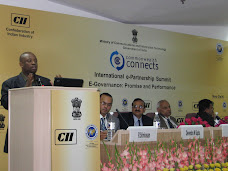
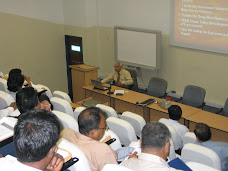
I made a presentation on Process Framework as Enabler of India’s National E-governance Plan (NeGP) on January 18, 2008 in the module on Making NeGP Happen: Views and Perceptions in recently concluded Electronics and Information Technology Exposition (ELITEX 2008), held on January 17-18, 2008 in New Delhi convened by Department of Information Technology. This is available at
http://www.elitex.in/paper2008/dcmisra.ppt#36 (accessed: January 23, 2008)
Dr D.C.Misra
January 23, 2008
Wednesday, January 23, 2008


Tuesday, January 01, 2008
Misra,D.C.(2008): Annual Survey of E-government 2008
Happy New Year!
I undertook an exercise and presented it in my keynote address on “Ten Emerging E-government Challenges Today: The Future may be Sober and not Hype” at the 4th International Conference on E-government (ICEG 2007) held at the Indian Institute of Technology (IIT), Delhi on December 15-17, 2006.
I had a look at this paper at the end of 2007, nearly after a year to see if these challenges required any addition/deletion or modification. As a result of this re-assessment I have added six more challenges and touched up my paper here and there to make it up-to-date.
This paper is available in the files section of the group moderated by me at:
http://tech.groups.yahoo.com/group/cyber_quiz
It is hoped e-government practitioners may find it useful in their professional work.
Dr D.C.Misra
January 1, 2008
I undertook an exercise and presented it in my keynote address on “Ten Emerging E-government Challenges Today: The Future may be Sober and not Hype” at the 4th International Conference on E-government (ICEG 2007) held at the Indian Institute of Technology (IIT), Delhi on December 15-17, 2006.
I had a look at this paper at the end of 2007, nearly after a year to see if these challenges required any addition/deletion or modification. As a result of this re-assessment I have added six more challenges and touched up my paper here and there to make it up-to-date.
This paper is available in the files section of the group moderated by me at:
http://tech.groups.yahoo.com/group/cyber_quiz
It is hoped e-government practitioners may find it useful in their professional work.
Dr D.C.Misra
January 1, 2008
Monday, December 03, 2007

Sunday, December 02, 2007
Misra,D.C.(2008): Review of Chen (2007): Electronic Engagement: A Guide for Public Sector Managers

Book Review
Public Sector Managers as “Responsive Entrepreneurs:” Will they deliver in developing countries?
by Dr D.C.Misra*
The Web-based e-government, launched more than a decade ago, has unleashed two unique and surging phenomena in the field of democracy, which, one must hasten to add, has also varying degrees of freedom in different democratic countries worldwide. First, it has made available a set of tools to citizens to express themselves online commenting upon the affairs of the state, particularly those that impact on her life. These include emails, online discussion groups, blogs, wiki, portals, etc. Secondly, it has created a new entity called electronic citizen or e-citizen, who has, within a short span of her birth, started clamouring for her e-rights and is also prepared to discharge e-duties.1
Despite this revolutionary development, the vast majority of citizens still keep aloof from the state. This creates a vicious cycle in practice. Lack of involvement of citizens in the affairs of the state gives rise to poor policy formulation and implementation. And poor policy formulation and implementation, in its turn, disenchants and alienates the citizen from the affairs of the state. This vicious cycle can, however, luckily be broken if information and communication technologies (ICTs) are used to engage citizens in the affairs of the state.
.
This is thus a very timely monograph** on the emerging subject of electronic engagement or e-engagement written by Dr Peter Chen, a Research Associate with the National Centre for Australian Studies, part of Faculty of Arts at Monash University. The Guide aims to ‘equip the public sector manager to assess the value that new communications and computing technology may bring to their interactions with a range of potential stakeholders. It is written for mangers who have an interest in expanding their approach to public engagement rather than information technology professionals.’
Realising their importance, the Australian Government has issued Principles for ICT-enabled Citizen Engagement (AGIMO n.d.). In a path-breaking step, the Australian Government also proposes to set up a Government Consultation Blog on “community feedback on how the government can utilise new internet technologies, such as blogs, to better consult with people.” through a discussion paper “Australian Government Consultation Blog Discussion Paper.” (AGIMO 2007). It envisages consultation blog as “a website that lists consultations and allows people to post responses, comments and feedback against each consultation.” (ibid.)
The book consists of a preface, an introduction, five chapters, a bibliography and two appendices. The five chapters are organized around introduction, definitions and approaches, designing the right plan and implementing it.
In Chapter 1, Introduction: An Information Age Democracy? The author defines e-engagement as ‘the use of Information Communication Technologies by the public sector to improve, enhance and expand the engagement of the public in policy-making processes’ and introduces contested concepts like public value (creating value like in private sector) (Moore 1995) and social capital2 (value in community and networking) (Van den Hooff, de Ridder and Aukema 2004), draws attention to the expanding role of public sector manager (requiring new skills and capabilities), describes information society and examines its implications, highlighting the fact that in the new environment public sector managers require new skills and capabilities.
In Chapter 2, Definitions, Differences and Approaches to eEngagement, Chen notes that there is a “wide array of competing, contested and conflicting definitions employed to describe” e-engagement (p-11). The role of public sector manager in electronically-facilitated democracy is, following Moore, “responsive entrepreneurs.” The relationship between the development of an electronically-facilitated democracy and the role of public sector manager is illustrated in Figure 1 along two axes – (vertical) nature of programmatic approach (role of government) and (horizontal) specificity of outcomes (from focused to diffused). This gives rise to three types of managerial roles: 1. Active Listening (passive management), 2. Cultivating Role (capacity building), and 3.Steering Role (high level of management and control) (p-17). These three roles or managerial approaches are also related as these will depend upon the stage of e-engagement project. In the end the author deals with digital divides, draws attention to multiple divides and indicates how these multiple divides can be bridged by a mix of information and communication technology (ICT) and traditional approaches and conceptualises “e-engagement” as a “highly effective way of motivating participation in the information economy.” (p-34).
In Chapter 3, Designing the Right Approach, the author suggests asking the following six questions for project planning: 1. What is the issue(s)? 2. Who are the audience(s)? 3. Consultation versus Collaboration? 4. What objectives do we have for this activity? 5. How interactive this process will be? and 6. What is the right channel (communications technology) to use? Answers to these questions, says the author, will “provide a solid foundation for an effective implementation plan” (p-38).
In Chapter 4, Implementation, the author lays stress on stakeholder buy-in, emphasising manage upwards (commitment from seniors), manage sideways (intra- and inter-government stakeholders), manage outwards (community members) and manage inwards (staff), and then deals with issues like managing technical issues, determining the software feature set, make or buy (software), propriety versus open source (software), low tech versus high tech, generating compelling content (and this is a challenging, often underestimated, task), compelling content versus eye candy (‘visual images that are pleasing to see but intellectually undemanding’), promotion and recruitment (for participation), conventional advertising and promotional approaches, the power of social networking (and its limitations), managing risk, security, and moderation (‘monitoring and exercising editorial control over message control’).
In the last concluding Chapter 5, Concluding the Process, the author emphasizes the importance of evaluation, noting that “Any project initiated in the public sector today will make provision for evaluation as a standard operating procedure.” (p-79). He recommends an evaluation tool of Whyte and Macintosh (2003) for e-engagement activities focusing on political, technical and social aspects. He then discusses close out processes, particularly their documentation, feedback and the eternal community.
Primarily written for the public sector managers of Australasia, this Guide will be found useful by public sector managers worldwide. The Australia and New Zealand School of Government (ANZSOG), Research School of Social Sciences, Australian National University (ANU) needs to be congratulated for bringing out this Guide on a subject whose importance is increasing day by day.
The phenomenal success of e-commerce has whetted the appetite of citizens for e-government of similar if not the same quality as e-commerce. In this scenario the traditional risk-averse precedent-quoting civil servants are under tremendous pressure to assume the new role of “responsive entrepreneurs” in their new re-incarnation as “public sector managers,” indicative of a shift from “regulatory administration” to “participatory management.” Chen notes:
While the classic bureaucratic model emphasized and rewarded strict technical expertise, the modern public sector manager is expected to have a range of ‘soft’ skills around coalition formation and stakeholder management. (p-4).
The days of regulatory rule-bound bureaucracy thus appear to be over. E-government has already sprouted worldwide and is fast showing signs of maturity. People are, however, not satisfied with mere e-government. They now want good e-government of which citizen engagement or e-engagement in policy formulation and implementation, indeed any aspect which affects their lives, is an integral part (Misra 2007). The issue, however, is not this premise which is sound. The issue is whether public sector managers, in their new role as “responsive entrepreneurs,” will deliver in developing countries?
Notes
1 The Dutch e-Citizen Charter, for example, consists of 10 quality requirements for a new relationship between citizen and government (Poelmans 2007)
2 Next to financial capital, physical capital (tools, machines and other productive equipment), human capital (an individual’s skills and capabilities), social capital is the fourth form of capital available to actors (Van den Hooff, de Ridder and Aukema 2004: 164-65).
References
AGIMO (Australian Government Information Management Office), Department of Finance and Administration, Australian Government (n.d.): Principles for ICT-enabled Citizen Engagement,
http://www.agimo.gov.au/__data/assets/pdf_file/0008/55745/Principles.pdf, accessed: September 25, 2007)
AGIMO (Australian Government Information Management Office), Department of Finance and Administration, Australian Government (2007): Australian Government Consultation Blog Discussion Paper, September, http://www.agimo.gov.au/__data/assets/pdf_file/0014/61601/Consultation_Blog_Discussion_Paper.pdf, accessed: September 25, 2007)
Misra, D.C. (2007): Select Aspects of Conceptual Foundations of E-government-2: Checking some of the Foundations (forthcoming). The first part of this three-part contribution, Select Aspects of Conceptual Foundations of E-government: Clearing the Fog for a Better Vision, has already been accepted for 5th International Conference on E-governance, December 28-30, 2007, Hyderabad, Andhra Pradesh, India (http://www.iceg.net/2007/)
Moore, Mark (1995): Creating Public Value: Strategic Management in Government, Cambridge, MA, Harvard University Press
Poelmans, Matt (2007): Dutch e-Citizen Charter Promotes Citizen-Centered Government, Government Technology, April 10, http://www.govtech.com/gt/articles/104894 (accesed: September 28, 2007)
Van den Hooff, Bart, Jan de Ridder and Eilene Aukema (2004): Exploring the Eagerness to Share Knowledge: The Role of Social Capital and ICT in Knowledge Sharing, in
Huysman, Marleen and Volker Wulf (eds.) (2004): Social Capital and Information Technology, Cambridge, MA, The MIT Press, June Chapter 7, pp 164-65, http://books.google.com/books?id=8uYbB1AeVrYC&printsec=frontcover#PPA165,M1, accessed: September 25, 2007)
Whyte, Angus and Ann Macintosh (2003): Analysis and Evaluation of E-Consultations, e-Service Journal, 2(1), http://www.e-sj.org/e-SJ2.1/esj2_1_whyte_macintosh.pdf (Abstract), accessed: September27, 2007)
____________________________________________________________________________________
*Independent E-government Researcher and Consultant, New Delhi, India. Formerly of Indian Administrative Service, Chairman, Task Force for IT Policy for Delhi and Chief Knowledge Officer, Ministry of Communications and Information Technology, Republic of Mauritius, Port Louis under the aegis of Commonwealth Secretariat, London. Email: dc_misra [at] hotmail.com
** Chen, Dr Peter (2007): Electronic Engagement: A Guide for Public Sector Managers, Canberra, ACT, Australia, ANU E Press, the Australia and New Zealand School of Government, the Australian National University, xvii+103 pp
Tuesday, November 20, 2007
Irish public servants believe that new technology has increased efficiency
Irish public servants surveyed believe that new technology has increased efficiency, according to a survey.
The vast majority (90pc) of the 42 Irish public servants surveyed by internet strategist Elucidate believe that technology initiatives they have carried out have made it easier for the public to contact the Government than it was two years ago, according to an article published in SiliconRepublic.com. Some 82pc believe new technology has made their units work more efficiently. Check the full article at:
http://www.siliconrepublic.com/news/news.nv?storyid=single9656 (accessed: November 20, 2007)
Dr D.C.Misra
November 20, 2007__________________________________________________________________
*Kennedy, John (2007): Poor funding a major obstacle to e-government, SiliconRepublic.com, November 19, 2007, http://www.siliconrepublic.com/news/news.nv?storyid=single9656 (accessed: November 20, 2007)
*Poor funding a major obstacle to e-government
19.11.2007 - Securing adequate funding is seen as the main obstacle to more government services being offered online, leading public servants have warned in a new survey.
The vast majority (90pc) of the 42 Irish public servants surveyed by internet strategist Elucidate believe that technology initiatives they have carried out have made it easier for the public to contact the Government than it was two years ago.
Some 82pc believe new technology has made their units work more efficiently.
Maeve Kneafsey of Elucidate, which will co-host the forthcoming eGovernment Awards, and who was last week appointed chair of the Irish Internet Association, says that 85.4pc of Ireland’s senior public servants believe e-government has led to significant customer service gains.
She said that faster access to information was cited by 61pc, while increased productivity was cited by 41.5pc as the highest rated benefit of e-government.
However, she warned that funding was an issue that may hold back future initiatives.
“It may be worth Minister Cowen’s time to note that securing adequate funding was given as one of the main obstacles to more services being offered online. Yet ‘online’ can deliver greater efficiencies with the public having access on a 24/7 basis, at a time that people choose, not just during ‘normal’ office hours.
“Just think of the many, many thousands who use the Revenue Online Service as well as the tremendous success of the Motor Tax Office’s online service. While the Minister is at it, he and his government colleagues should also note that all of the respondents said there should be more incentives for people to use e-government initiatives, such as the extra time that is already allowed for people to pay taxes online,” Kneafsey said.
Kneafsey added that if the Irish Government is serious about getting more for less, in gaining greater productivity from all public services, then the future has got to be online.
“A big drive towards e-government could deliver a double whammy of being self-financing while giving the taxpayer an improved service. One final figure that is telling is that over two thirds of the respondents said that driving people to use online services was their No 1 priority, but almost the same number said they needed more resources to publicise the services,” Kneafsey said.
By John Kennedy
(Source: http://www.siliconrepublic.com/news/news.nv?storyid=single9656 (accessed: November 20, 2007)
The vast majority (90pc) of the 42 Irish public servants surveyed by internet strategist Elucidate believe that technology initiatives they have carried out have made it easier for the public to contact the Government than it was two years ago, according to an article published in SiliconRepublic.com. Some 82pc believe new technology has made their units work more efficiently. Check the full article at:
http://www.siliconrepublic.com/news/news.nv?storyid=single9656 (accessed: November 20, 2007)
Dr D.C.Misra
November 20, 2007__________________________________________________________________
*Kennedy, John (2007): Poor funding a major obstacle to e-government, SiliconRepublic.com, November 19, 2007, http://www.siliconrepublic.com/news/news.nv?storyid=single9656 (accessed: November 20, 2007)
*Poor funding a major obstacle to e-government
19.11.2007 - Securing adequate funding is seen as the main obstacle to more government services being offered online, leading public servants have warned in a new survey.
The vast majority (90pc) of the 42 Irish public servants surveyed by internet strategist Elucidate believe that technology initiatives they have carried out have made it easier for the public to contact the Government than it was two years ago.
Some 82pc believe new technology has made their units work more efficiently.
Maeve Kneafsey of Elucidate, which will co-host the forthcoming eGovernment Awards, and who was last week appointed chair of the Irish Internet Association, says that 85.4pc of Ireland’s senior public servants believe e-government has led to significant customer service gains.
She said that faster access to information was cited by 61pc, while increased productivity was cited by 41.5pc as the highest rated benefit of e-government.
However, she warned that funding was an issue that may hold back future initiatives.
“It may be worth Minister Cowen’s time to note that securing adequate funding was given as one of the main obstacles to more services being offered online. Yet ‘online’ can deliver greater efficiencies with the public having access on a 24/7 basis, at a time that people choose, not just during ‘normal’ office hours.
“Just think of the many, many thousands who use the Revenue Online Service as well as the tremendous success of the Motor Tax Office’s online service. While the Minister is at it, he and his government colleagues should also note that all of the respondents said there should be more incentives for people to use e-government initiatives, such as the extra time that is already allowed for people to pay taxes online,” Kneafsey said.
Kneafsey added that if the Irish Government is serious about getting more for less, in gaining greater productivity from all public services, then the future has got to be online.
“A big drive towards e-government could deliver a double whammy of being self-financing while giving the taxpayer an improved service. One final figure that is telling is that over two thirds of the respondents said that driving people to use online services was their No 1 priority, but almost the same number said they needed more resources to publicise the services,” Kneafsey said.
By John Kennedy
(Source: http://www.siliconrepublic.com/news/news.nv?storyid=single9656 (accessed: November 20, 2007)
Thursday, November 15, 2007
Cyber Law and E-governance: Which Model is Better-the EU Model or the U.S.Model for a Developing Country?
The following question arise:
(a) What is cyber law? In what way does it distinguish from other types of law? How does creation of a separate class of law (cyber law) help legal enablement of e-governance? And why indeed is legal enablement needed and for whom?
(b) Which is larger, legally valid construct, cyber law or e-governance? (In other words, should cyber law (legally) govern e-governance or should it be the other round, that is, e-governance should govern cyber law?)
(c) What are the objectives of cyber law (and, for that matter, e-governance law)? Is it protection of life and liberties of a citizen (empowerment of citizen) or empowering the state or regulating the cyberspace?
(d) Is cyberspace not already over-regulated (from the point of view of citizen) via existing legal codes (do we not already have enough legal powers to regulate our behaviour in cyberspace?), software code (your activities in cyberspace are regulated by what the software allows you to do, nothing more nor less), and e-commerce (you will buy only what I offer and you will purchase the way I want you to do, etc.) (Check Lessig’s Code).
(e) Where and how to demarcate a cyber crime from unethical practices in cyberspace (for example, collecting your personal information before allowing you entry to a portal and subsequently misusing this information for sending promotional newsletters, or not providing for unsubscription or unsubscription link just not working, etc.)
(f) What for “generic model laws for building cyber law capacity for e-Governance” needed? What are the concrete instances/cases in which the existing laws have been found inadequate or vague in e-governance in G2G and G2C domains? Is the exercise normative (prescribing what to do) or empirical (finding what is the ground-level reality)?
(g) Should cyber law regulate e-governance policy [European Union (EU) model] or e-governance policy should regulate development of cyber law [US model- see (h)] below? What is our e-governance policy (as distinct from IT/ICT policy)? Are you aware of any e-governance policy as a written commitment for e-governance development in any country?
(h) In contrast with EU model, the U.S., the only country in the world to have done so (to my knowledge, of course), enacted the legislation- The E-government Act of 2002. Which model is better- the EU model or the U.S. model?
Is it not better to check foundations first, and then erect the building, rather than first construct the building and then worry whether our foundations are sound?
Dr D.C.Misra
November 15, 2007
(a) What is cyber law? In what way does it distinguish from other types of law? How does creation of a separate class of law (cyber law) help legal enablement of e-governance? And why indeed is legal enablement needed and for whom?
(b) Which is larger, legally valid construct, cyber law or e-governance? (In other words, should cyber law (legally) govern e-governance or should it be the other round, that is, e-governance should govern cyber law?)
(c) What are the objectives of cyber law (and, for that matter, e-governance law)? Is it protection of life and liberties of a citizen (empowerment of citizen) or empowering the state or regulating the cyberspace?
(d) Is cyberspace not already over-regulated (from the point of view of citizen) via existing legal codes (do we not already have enough legal powers to regulate our behaviour in cyberspace?), software code (your activities in cyberspace are regulated by what the software allows you to do, nothing more nor less), and e-commerce (you will buy only what I offer and you will purchase the way I want you to do, etc.) (Check Lessig’s Code).
(e) Where and how to demarcate a cyber crime from unethical practices in cyberspace (for example, collecting your personal information before allowing you entry to a portal and subsequently misusing this information for sending promotional newsletters, or not providing for unsubscription or unsubscription link just not working, etc.)
(f) What for “generic model laws for building cyber law capacity for e-Governance” needed? What are the concrete instances/cases in which the existing laws have been found inadequate or vague in e-governance in G2G and G2C domains? Is the exercise normative (prescribing what to do) or empirical (finding what is the ground-level reality)?
(g) Should cyber law regulate e-governance policy [European Union (EU) model] or e-governance policy should regulate development of cyber law [US model- see (h)] below? What is our e-governance policy (as distinct from IT/ICT policy)? Are you aware of any e-governance policy as a written commitment for e-governance development in any country?
(h) In contrast with EU model, the U.S., the only country in the world to have done so (to my knowledge, of course), enacted the legislation- The E-government Act of 2002. Which model is better- the EU model or the U.S. model?
Is it not better to check foundations first, and then erect the building, rather than first construct the building and then worry whether our foundations are sound?
Dr D.C.Misra
November 15, 2007
Saturday, November 10, 2007
XIth National Conference on e-Governance, February 7-8, 2008, Panchkula, Haryana
Event:
XIth National Conference on e-Governance, February 7-8, 2008, Panchkula, Haryana
Department of Administrative Reforms and Public Grievances (DARPG), Ministry of Personnel, Public Grievances and Pensions, Government of India has been very successfully organizing a National Conference on E-governance (NCEG) every year. Many serving civil servants and some retired civil servants like me always look forward to this annual event. The DARPG needs to be congratulated for organising the next conference early next year.
The XIth National Conference on e-Governance will be held on
February 7-8, 2008 in
Panchkula, Haryana
in co-operation with the Department of Information Technology, Government of India and Government of Haryana, according to an announcement.
The theme of the conference is:
Integrated Citizen Services – Issues and Challenges.
for details, check the website:
http://darpg.nic.in/arpg-website/egov_conf.htm
--Dr D.C.Misra
November 10, 2007
XIth National Conference on e-Governance, February 7-8, 2008, Panchkula, Haryana
Department of Administrative Reforms and Public Grievances (DARPG), Ministry of Personnel, Public Grievances and Pensions, Government of India has been very successfully organizing a National Conference on E-governance (NCEG) every year. Many serving civil servants and some retired civil servants like me always look forward to this annual event. The DARPG needs to be congratulated for organising the next conference early next year.
The XIth National Conference on e-Governance will be held on
February 7-8, 2008 in
Panchkula, Haryana
in co-operation with the Department of Information Technology, Government of India and Government of Haryana, according to an announcement.
The theme of the conference is:
Integrated Citizen Services – Issues and Challenges.
for details, check the website:
http://darpg.nic.in/arpg-website/egov_conf.htm
--Dr D.C.Misra
November 10, 2007
Subscribe to:
Posts (Atom)

 Posts
Posts